

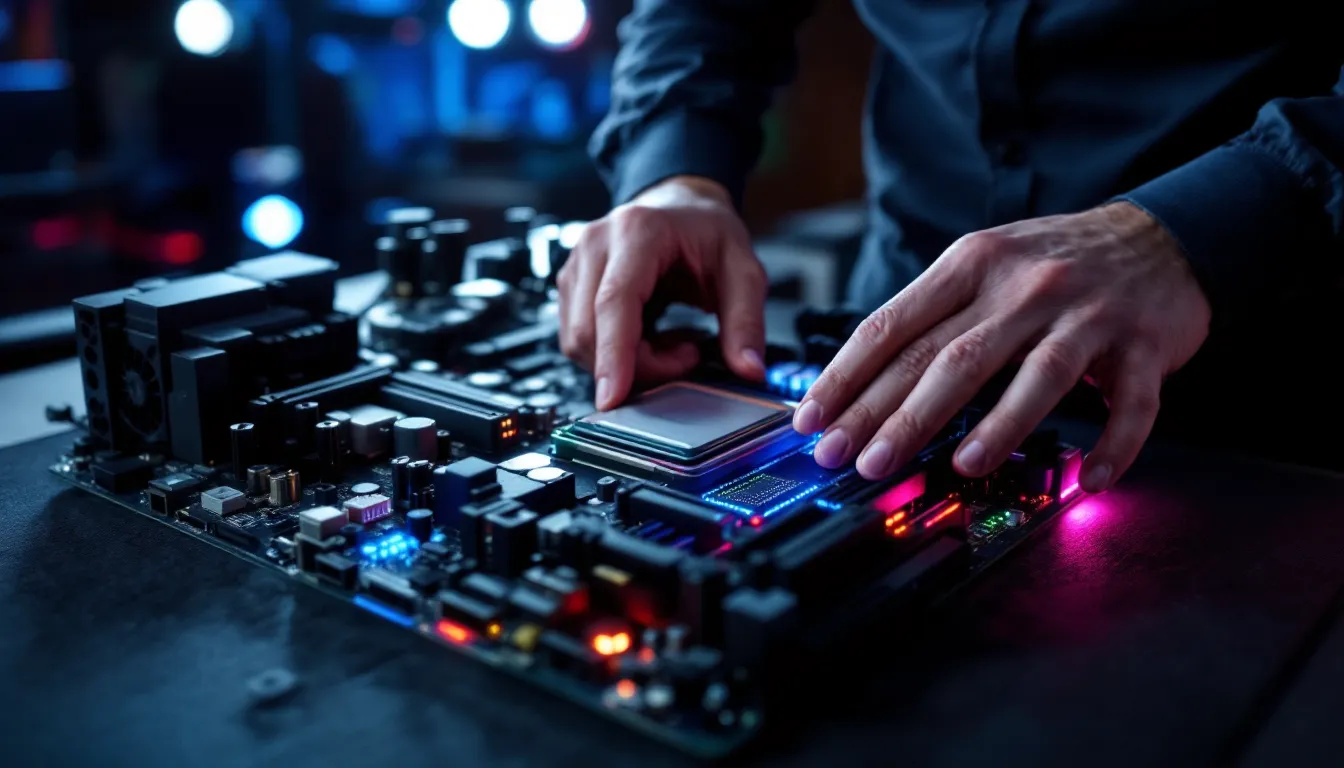
Building a gaming rig in 2026? The motherboard and CPU form the backbone of your system, and choosing them as a combo isn’t just about compatibility, it’s about squeezing every frame and minimizing bottlenecks. With Intel’s LGA1851 socket and AMD’s AM5 platform both mature and fighting for dominance, the decision gets trickier by the month. Grab the wrong pairing and you’re leaving performance on the table or blowing budget on features you’ll never use.
This guide cuts through the noise. Whether you’re dropping $250 or $1,500 on your motherboard CPU combo for gaming, you’ll learn which platform fits your play style, what features actually matter for gaming performance, and how to avoid the rookie mistakes that lead to thermal throttling or compatibility headaches. Let’s build something that lasts.
Key Takeaways
- A gaming motherboard CPU combo ensures socket compatibility, chipset optimization, and stable performance by pairing matched components that unlock the CPU’s full potential through proper VRM power delivery and memory support.
- AMD’s AM5 platform offers longer socket support through 2027+ with better efficiency and future upgrade flexibility, while Intel’s LGA1851 delivers peak single-threaded performance for competitive gaming but with shorter platform longevity.
- For 1080p-1440p gaming, 6-8 performance cores with boost clocks above 5.4 GHz are sufficient; the Ryzen 7 9700X and Intel i7-15700K represent the optimal mid-range balance at $500-$580, while the 9800X3D dominates pure gaming performance per dollar.
- VRM quality (14+2 phase minimum for mid-range CPUs), PCIe 5.0 support, and adequate M.2 heatsinks are the most critical features for gaming performance and thermal stability, with overclocking providing only 5-10% gains in GPU-limited scenarios.
- Proper CPU installation, XMP/EXPO memory profile enabling, and avoiding common assembly mistakes like loose CPU power connectors or improperly seated RAM are essential for stable first-boot and preventing costly hardware failures.
- Planning for socket longevity matters: choose AMD AM5 if you want 3+ generations of drop-in CPU upgrades, or budget for a complete platform refresh with Intel every 4 years to avoid obsolescence.
What Is a Motherboard CPU Combo and Why Does It Matter?
A motherboard CPU combo is exactly what it sounds like: the processor and mainboard purchased together as a matched pair. These two components form the central nervous system of your gaming PC, handling everything from game logic and AI calculations to asset streaming and frame delivery.
Buying them as a combo, whether from a retailer bundle or chosen together intentionally, ensures socket compatibility, chipset optimization, and often better pricing than piecing them out separately. Screw this up and your CPU won’t physically fit the board, or worse, it’ll fit but run like garbage due to poor power delivery or BIOS incompatibility.
Understanding Socket Compatibility and Chipset Basics
Sockets are physical CPU mounting standards, and they’re non-negotiable. Intel’s current mainstream gaming socket is LGA1851 (introduced with Arrow Lake in late 2024), while AMD runs on AM5 for Ryzen 7000 and 8000-series chips. Drop an Intel chip in an AMD board? Not happening.
Chipsets sit on the motherboard and dictate what the CPU can actually do. Intel’s Z890 chipset unlocks overclocking and gives you the most PCIe lanes, while B860 trims features to cut cost. On the AMD side, X870E and X870 offer full PCIe 5.0 support and robust VRM setups, while B850 hits the sweet spot for most gamers. Lower-end chipsets like A620 save cash but sacrifice overclocking and I/O flexibility.
Socket and chipset compatibility isn’t just about making it boot. Mismatched combos can bottleneck your GPU, limit RAM speeds, or choke M.2 SSD performance. The chipset also determines how many USB ports, SATA drives, and RGB headers you get, stuff that matters when you’re actually building.
Performance Benefits of Matched Components
Pairing a CPU with the right motherboard isn’t just plug-and-play, it’s about unlocking full potential. A high-end Intel Core i7-15700K on a cheap H810 board? You’re leaving overclocking headroom, memory speeds, and thermal performance on the floor.
Matched components ensure VRM (Voltage Regulator Module) quality can handle the CPU’s power draw under load. Push a 14-core chip on a 4+2 phase VRM board and expect thermal throttling during long gaming sessions or rendering tasks. Quality combos pair beefy CPUs with equally robust power delivery, keeping clock speeds stable when it counts.
You also get better memory compatibility. DDR5 is standard in 2026, but not all boards run it at the same speeds. A Z890 or X870 board will comfortably handle DDR5-6400 or faster, while budget chipsets might cap you at DDR5-5200. That gap can mean 5-10% performance swings in memory-sensitive titles like Starfield or Counter-Strike 2.
Finally, matched combos often come pre-validated for BIOS stability. Retailers and manufacturers test these pairings, so you’re less likely to encounter POST failures or cryptic boot errors. It’s the difference between gaming in an hour versus troubleshooting for three.
Intel vs AMD: Choosing the Right Platform for Your Gaming Needs
Intel and AMD have traded blows for years, and in 2026 both platforms deliver serious gaming chops. The decision hinges on your priorities: raw single-threaded speed, multi-core workloads, platform longevity, or budget.
Intel Platform Advantages and Current Socket Standards
Intel’s LGA1851 socket powers the 15th-gen Arrow Lake-S lineup, launched in late 2024 and refined through 2025. The flagship Core i9-15900K packs 24 cores (8 P-cores, 16 E-cores) and boosts north of 6.0 GHz on performance cores, delivering blistering single-threaded performance that still edges AMD in many competitive shooters and esports titles.
Intel’s strength lies in high clock speeds and mature driver ecosystems. Games like Valorant, CS2, and Overwatch 2 love that single-core grunt, and Intel’s Thread Director tech does a solid job routing tasks between P-cores and E-cores without manual tweaking.
The platform also enjoys robust DDR5 support with speeds up to DDR5-6800 on Z890 boards, plus widespread PCIe 5.0 for GPUs and storage. Intel’s chipset lineup (Z890, B860, H810) offers clear segmentation, so you know exactly what you’re sacrificing when stepping down.
Downside? Power consumption. Intel chips still pull hefty wattage under load, expect 250W+ on the i9-15900K when overclocked. That means beefier cooling and higher electricity bills. Socket longevity is also questionable: Intel tends to switch sockets more frequently than AMD, which can limit future upgrade paths.
AMD Platform Strengths and AM5 Socket Features
AMD’s AM5 socket debuted with Ryzen 7000 in late 2022 and has since welcomed Ryzen 8000-series chips (Zen 5 architecture) throughout 2025. The platform’s killer feature is longevity, AMD has committed to supporting AM5 through at least 2027, meaning you can drop in next-gen CPUs without swapping motherboards.
The Ryzen 9 9950X and Ryzen 7 9800X3D are standout gaming chips. The 9800X3D, with its 3D V-Cache tech, dominates in open-world and simulation games where cache capacity matters. Titles like Cyberpunk 2077, Baldur’s Gate 3, and Microsoft Flight Simulator 2024 see double-digit percentage gains over non-X3D chips.
AMD also wins on efficiency. Ryzen 9000-series chips typically pull 30-50W less than Intel equivalents under gaming loads, translating to quieter builds and lower cooling requirements. AM5 boards universally support DDR5 and PCIe 5.0, and AMD’s EXPO memory profiles simplify RAM overclocking.
The trade-off? Peak single-threaded clocks lag slightly behind Intel, which can mean 3-5% lower FPS in CPU-bound esports titles. AMD’s chipset naming (X870E, X870, B850, A620) can also confuse newcomers, though performance tiers are similar to Intel’s.
Price-to-Performance Comparison for Gaming
In early 2026, AMD generally delivers better value in the mid-range. A Ryzen 7 9700X paired with a B850 board runs around $450-$500 and crushes 1440p gaming across the board. Intel’s comparable i7-15700K with a B860 board sits closer to $500-$550 but pulls ahead in esports titles.
At the high end, it’s a wash. The i9-15900K and Ryzen 9 9950X trade blows depending on the workload, both hovering around $600-$650 for CPU alone. Pair them with Z890 or X870E boards and you’re looking at $900-$1,100 combos. The 9800X3D, priced around $480, offers the best pure gaming performance per dollar spent if you’re not streaming or rendering.
Budget tier favors AMD slightly. Ryzen 5 9600X with an A620 board can be had for under $280, while Intel’s i5-15400 with H810 pricing sits closer to $300. Both handle 1080p gaming fine, but AMD’s upgrade path to future Ryzen chips on the same socket sweetens the deal.
Platform costs extend beyond the CPU and board. Intel builds often need beefier coolers and PSUs due to higher TDP, while AMD’s efficiency can shave $50-$100 off auxiliary components.
Best Gaming Motherboard CPU Combos for Different Budgets
Budget dictates reality. Here’s what to buy at each price tier in 2026, with specific combos that balance performance, features, and future-proofing.
Budget-Friendly Combos Under $300
If you’re building your first rig or targeting 1080p 60+ FPS gaming, these combos deliver without embarrassing compromises.
AMD: Ryzen 5 9600 + ASRock B850M Pro4 (~$270)
The 9600 brings 6 cores and 12 threads with a 5.1 GHz boost, enough for modern AAA titles and esports staples. The ASRock B850M Pro4 offers DDR5-6400 support, one PCIe 5.0 x16 slot, and dual M.2 slots. VRM is adequate (10+2 phase) for stock operation, and you get Wi-Fi 6E at this price point. No overclocking, but the 9600 doesn’t need it.
Intel: Core i5-15400F + MSI PRO B860M-A (~$290)
The 15400F (10 cores: 6 P-cores, 4 E-cores) trades blows with the 9600 in gaming and pulls ahead in productivity. MSI’s B860M-A includes DDR5-5600 support, solid I/O, and reliable BIOS. The “F” suffix means no integrated graphics, so factor in a discrete GPU (which you need for gaming anyway).
Performance expectations: 1080p high/ultra settings in most 2026 titles, 144+ FPS in competitive shooters, and enough CPU headroom to avoid GPU bottlenecks with mid-range cards like the RTX 5060 or RX 8600 XT.
Mid-Range Powerhouses ($300-$600)
This bracket is the sweet spot, enough power for 1440p high-refresh gaming, streaming, and light content creation without diminishing returns.
AMD: Ryzen 7 9700X + ASUS TUF Gaming B850-PLUS WIFI (~$520)
The 9700X (8 cores, 16 threads, 5.4 GHz boost) is an efficiency monster, sipping ~88W under load. ASUS TUF boards are workhorses: 14+2 phase VRM, DDR5-7200 EXPO support, three M.2 slots with heatsinks, and 2.5G Ethernet. This combo handles 1440p 144Hz gaming and medium-load streaming without breaking a sweat. According to testing from Tom’s Hardware, the 9700X consistently delivers within 5% of the 9800X3D in non-cache-sensitive titles.
Intel: Core i7-15700K + MSI MAG Z890 TOMAHAWK WIFI (~$580)
The 15700K (20 cores: 8 P-cores, 12 E-cores, 5.6 GHz P-core boost) thrives in mixed workloads. MSI’s Z890 Tomahawk is a proven overclocker platform with 16+2 phase VRM, DDR5-8000+ support, and robust cooling. Unlocked multiplier means you can push clocks if you’ve got the cooling. Expect 10-15% higher productivity performance than the 9700X, with similar gaming FPS.
AMD X3D Option: Ryzen 7 9800X3D + ASRock X870 Pro RS (~$650)
If pure gaming is the goal, the 9800X3D’s 96 MB of 3D V-Cache demolishes cache-sensitive games. Paired with ASRock’s X870 Pro RS (which offers PCIe 5.0 lanes and USB4 support), this combo tops gaming benchmarks in titles like Baldur’s Gate 3, Total War: Pharaoh Dynasties, and Star Citizen. It’s the ceiling for 1440p and a strong pick for 4K gaming.
High-End Enthusiast Combos ($600+)
Enthusiast territory means no compromises: 4K gaming, high-refresh 1440p, heavy multi-tasking, and future-proofing for next-gen GPUs.
AMD: Ryzen 9 9950X + ASUS ROG Strix X870E-E Gaming WIFI (~$1,100)
The 9950X (16 cores, 32 threads, 5.7 GHz boost) is overkill for pure gaming but crushes simultaneous streaming, rendering, and VM workloads. ASUS ROG Strix X870E boards are loaded: 18+2 phase VRM rated for 300W+, DDR5-8000+ OC support, five M.2 slots, USB4, and 10G Ethernet. Reviews from PCWorld highlight this combo’s ability to maintain 5.5 GHz all-core under AVX2 workloads with adequate cooling.
Intel: Core i9-15900K + GIGABYTE Z890 AORUS MASTER (~$1,150)
The 15900K (24 cores: 8 P-cores, 16 E-cores, 6.0 GHz P-core boost) is Intel’s flagship monster. Gigabyte’s Aorus Master matches it with absurd VRM overkill (20+2 phase), DDR5-8800 support, Thunderbolt 5, and dual 10G Ethernet. This pairing is built for extreme overclocking, 4K 120Hz gaming, and professional workloads. Power draw approaches 350W when pushed, so plan cooling and PSU accordingly.
Performance ceiling: Both combos pair seamlessly with RTX 5090 or RX 9900 XT GPUs, eliminate CPU bottlenecks at any resolution, and offer headroom for the next 3-4 years of GPU upgrades.
Key Features to Look for in a Gaming Motherboard
Not all motherboards are built equal, even within the same chipset. Here’s what actually impacts gaming performance and build quality.
VRM Quality and Power Delivery for Stable Performance
Voltage Regulator Modules (VRMs) convert your PSU’s 12V power into the lower voltages your CPU needs. Cheap VRMs overheat, causing the CPU to throttle and tank performance during sustained loads.
Look for phase count and heatsink coverage. A 12+2 phase design (12 for CPU cores, 2 for integrated graphics/memory controller) is the minimum for mid-range chips. High-end CPUs demand 14-18+ phases. ASUS TUF, MSI MAG, and Gigabyte Aorus lines typically deliver here.
Thermal sensors on VRMs are a plus, they let you monitor temps in real-time. If VRM temps push past 90°C under load, expect instability or reduced boost clocks. Quality boards keep VRMs under 70°C even during stress tests.
Don’t trust marketing fluff like “military-grade components.” Check third-party reviews from sites like Hardware Times that measure VRM temps and power delivery under real-world gaming and rendering loads.
PCIe Slots, M.2 Support, and Expansion Options
Your GPU lives in the top PCIe x16 slot, and in 2026 you want PCIe 5.0 support. Even though most GPUs don’t saturate PCIe 4.0 yet, future-proofing matters if you plan to keep this board through 2028+. PCIe 5.0 also enables insanely fast NVMe SSDs (14+ GB/s read speeds), cutting load times in open-world games.
Count your M.2 slots, two is minimum, three is ideal. Make sure at least one supports PCIe 5.0 x4. Check whether slots share bandwidth with SATA ports: some budget boards disable SATA ports when certain M.2 slots are populated, which can surprise you mid-build.
Additional PCIe x1 or x4 slots matter if you’re adding capture cards, Wi-Fi upgrades, or sound cards. Most gamers won’t need them, but streamers and modders should verify slot layout before buying.
Cooling Solutions and Thermal Management
Active chipset cooling (small fans) used to be common on high-end boards, but in 2026 most rely on passive heatsinks. That’s fine, modern chipsets run cooler, but make sure M.2 heatsinks are included and properly designed. Drives can throttle at 70°C+, killing your SSD’s advertised speeds.
Some boards include backplate reinforcement around the CPU socket to prevent PCB warping under heavy cooler pressure. If you’re mounting a 1.5 kg tower cooler, this feature adds peace of mind.
Fan headers are often overlooked. Budget boards give you 3-4 headers: enthusiast boards offer 6-8+, often with hybrid PWM/DC support and high amp ratings. More headers mean better airflow tuning and fewer splitters cluttering your cable management.
Connectivity: USB, Ethernet, and Wi-Fi Options
Rear I/O matters more than you’d think. At minimum, demand USB 3.2 Gen 2 (10 Gbps) Type-A and Type-C ports. USB4 or Thunderbolt 4/5 support is a bonus for external GPUs or high-speed storage.
For networking, 2.5G Ethernet is standard in 2026: 10G Ethernet appears on high-end boards and helps if you’re streaming to multiple devices or running a NAS. Wi-Fi 6E or Wi-Fi 7 is essential if you’re going wireless, older Wi-Fi 6 struggles with low-latency gaming in congested environments.
Internal USB headers for front-panel ports are easy to miss but annoying when absent. Verify the board has USB 3.2 Gen 1 (5 Gbps) headers and at least one USB-C header if your case supports it.
CPU Selection: Cores, Clock Speeds, and Gaming Optimization
CPU specs can be confusing. Here’s what actually matters for gaming in 2026, and where diminishing returns kick in.
How Many Cores Do You Really Need for Gaming?
For pure 1080p-1440p gaming, 6 performance cores is the sweet spot. Games like Call of Duty: Black Ops Gulf War, Fortnite, and Apex Legends rarely scale past 8 threads. A Ryzen 5 9600 or Intel i5-15400F handles these titles without bottlenecking mid-range GPUs.
If you stream, run Discord, browser tabs, and Spotify simultaneously, bump to 8 cores. The Ryzen 7 9700X or i7-15700K provides headroom so background tasks don’t crater your FPS.
12+ cores (like the i9-15900K or Ryzen 9 9950X) only matter if you’re rendering, compiling code, or running heavy VMs alongside gaming. In pure gaming scenarios, the extra cores sit idle or get assigned low-priority tasks. You’re paying for capability you won’t use unless your workflow extends beyond gaming.
Intel’s E-cores (efficiency cores) complicate the math. An i7-15700K’s 8 P-cores + 12 E-cores can juggle background processes better than a traditional 8-core chip, but Windows 11’s Thread Director needs to be functioning properly to route tasks intelligently. In practice, it works well as of late 2025 patches.
Clock Speed vs Multi-Threading for Different Game Types
Single-threaded performance (high clock speeds on individual cores) dominates in competitive shooters and esports titles. Valorant, CS2, and Rainbow Six Siege love CPUs that boost above 5.5 GHz on one or two cores. Intel chips often edge AMD here, though the Ryzen 9000-series has closed the gap significantly.
Multi-threaded performance shines in simulation, strategy, and open-world RPGs. Cities: Skylines II, Total War games, and Starfield leverage 12+ threads, making higher core counts worthwhile. AMD’s X3D chips (like the 9800X3D) split the difference by combining solid clocks with massive cache, letting fewer cores punch above their weight.
Clock speed alone doesn’t tell the story, IPC (instructions per cycle) matters too. AMD’s Zen 5 and Intel’s Arrow Lake architectures both improved IPC over prior gens, so a 5.2 GHz Zen 5 core can outperform a 5.4 GHz older Zen 4 core in certain workloads.
For mixed-use gaming PCs, prioritize boost clocks over base clocks. A CPU that boosts to 5.6 GHz for short bursts beats one that sits at 4.8 GHz all-core in bursty gaming workloads.
Overclocking Potential and Thermal Considerations
Overclocking in 2026 yields smaller gains than it did a decade ago, CPUs already boost aggressively out of the box. That said, unlocked Intel K-series chips and AMD X-series CPUs offer 200-400 MHz headroom if you’ve got cooling to match.
Manual overclocking requires a Z890 (Intel) or X870/B850 (AMD) motherboard with solid VRM. Expect 5-10% performance gains in CPU-bound scenarios, but diminishing returns in GPU-limited gaming. The real benefit is tighter memory tuning, pushing DDR5 from 6000 MT/s to 7200 MT/s can yield 3-8% FPS gains in certain titles.
Thermals become the limiting factor fast. Intel’s i9-15900K can pull 300W+ when overclocked, requiring 360mm AIOs or high-end air coolers (Noctua NH-D15, be quiet. Dark Rock Pro 5). AMD’s Ryzen chips run cooler, but the 9800X3D still benefits from 280mm+ liquid cooling to maintain boost clocks during long sessions.
PBO (Precision Boost Overdrive) on AMD and Turbo Boost Max 3.0 on Intel are auto-overclocking features that intelligently push clocks based on thermal headroom. For most gamers, enabling these in BIOS and letting the CPU self-tune delivers 80% of manual OC gains with zero hassle.
Form Factors Explained: ATX, Micro-ATX, and Mini-ITX
Motherboard size impacts case compatibility, expansion options, and sometimes performance. Here’s how to choose.
Choosing the Right Size for Your Build
ATX (305 x 244 mm) is the standard. Most mid-tower and full-tower cases support ATX, and these boards offer the most PCIe slots, M.2 slots, and fan headers. If you’re building a primary gaming rig with room for future expansion (capture cards, extra storage, etc.), ATX is the safe bet.
Micro-ATX (244 x 244 mm) trims a few inches but retains most features. You’ll typically lose one or two PCIe slots and maybe a fan header, but core specs, VRM, M.2 support, connectivity, remain solid. Micro-ATX fits compact mid-tower cases and costs $20-$50 less than equivalent ATX boards. Great for budget or space-conscious builds where you don’t need tons of expansion.
Mini-ITX (170 x 170 mm) is the smallest mainstream size, limited to one PCIe x16 slot and usually two M.2 slots. These boards fit ultra-compact SFF (small form factor) cases, making them ideal for LAN rigs or living room PCs. The trade-off is tighter layouts, which can complicate cooling and cable management. Prices often match or exceed ATX due to engineering challenges in cramming features into limited PCB space.
Pick based on your case first, then your expansion needs. No point buying an ATX board if your case only fits Micro-ATX, and vice versa.
Performance Trade-Offs and Limitations
Form factor rarely impacts gaming performance directly, a well-designed Mini-ITX board with solid VRM performs identically to an ATX equivalent in benchmarks. The differences show up in thermal management and expansion.
Smaller boards cram components closer together, which can elevate VRM and chipset temps in poorly ventilated cases. If you’re running a high-TDP CPU (i9-15900K, Ryzen 9 9950X) in a Mini-ITX build, invest in case fans and verify VRM heatsink quality.
Micro-ATX and Mini-ITX boards also limit future upgrades. With only one or two PCIe slots, you can’t add capture cards, sound cards, or extra NVMe adapters without sacrificing your GPU slot. Fewer fan headers mean more splitters or a fan hub, adding cost and clutter.
ATX boards provide breathing room, literally and figuratively. They space components out for better airflow, offer more headers and slots, and simplify builds. Unless you’re specifically targeting a compact build, ATX is the easiest path.
Installation and Setup Tips for Your Motherboard CPU Combo
Even the best components fail if installed incorrectly. Here’s how to avoid the common pitfalls that brick hardware or kneecap performance.
Proper CPU Installation and Thermal Paste Application
CPU installation is straightforward but unforgiving. For AMD AM5, lift the retention arm, align the CPU’s gold triangle with the socket’s triangle marker, and drop it in, no force required. Lower the arm to lock. For Intel LGA1851, lift the retention bracket, align notches, place the CPU gently, and close the bracket. You’ll hear a crunch: that’s normal and terrifying every time.
Never force the CPU. If it doesn’t seat smoothly, you’ve misaligned it. Forcing bends pins (AMD) or damages contact pads (Intel), and both are expensive mistakes.
Thermal paste application depends on cooler type. For most air and AIO coolers, a pea-sized dot (4-5 mm) in the center of the CPU spreader works. The cooler’s mounting pressure spreads it evenly. Pre-applied paste on stock coolers is adequate but not optimal, aftermarket paste (Thermal Grizzly Kryonaut, Noctua NT-H2) drops temps by 2-4°C.
Avoid the “spread it yourself” method unless you know what you’re doing. Too much paste acts as an insulator: too little leaves gaps. When in doubt, less is more.
BIOS Setup and Initial Configuration
First boot takes you to BIOS/UEFI. Before installing Windows, verify a few critical settings:
- Enable XMP/EXPO (memory overclocking profiles). Your DDR5-6400 RAM runs at DDR5-4800 (JEDEC spec) until you enable the profile. This alone can boost FPS by 5-10% in memory-sensitive games.
- Set boot priority to your OS drive (usually the first M.2 slot). Prevents boot loops or trying to boot from empty drives.
- Enable Resizable BAR (ReBAR) if your GPU supports it (most 2024+ cards do). ReBAR lets the CPU access full GPU memory, netting 3-8% FPS gains in some titles.
- Update BIOS if a newer version is available. Early BIOS revisions often have stability issues, RAM compatibility bugs, or missing AGESA updates (AMD). Check the motherboard manufacturer’s website and flash via USB if needed.
Don’t tweak voltages or advanced timings yet. Get the system stable on stock settings, install Windows, then circle back to performance tuning once drivers are loaded.
Common Mistakes to Avoid During Assembly
Forgetting the I/O shield. Install it before mounting the motherboard. Forgetting means removing the board later, and nobody wants that.
Improper standoff placement. Use only the standoffs that align with your motherboard’s screw holes. Extra standoffs can short the PCB. Missing standoffs can crack the board when you tighten screws.
Over-tightening screws. Motherboard screws should be snug, not gorilla-tight. Over-torquing cracks PCB traces or warps the board, causing POST failures or intermittent crashes.
Skipping the 8-pin CPU power connector. It’s tucked near the top-left of most boards and easy to overlook. The system won’t boot without it, leading to confusion and wasted time.
Seating RAM incorrectly. DDR5 DIMMs need firm, even pressure on both ends until the retention clips snap into place. Half-seated RAM causes no POST or single-channel mode, tanking performance.
Blocking airflow. Cable management isn’t just aesthetic. Loose cables blocking GPU or CPU cooler intake can spike temps by 10-15°C, triggering thermal throttling.
Future-Proofing Your Gaming PC: Upgrade Paths and Longevity
A smart combo today should support upgrades tomorrow. Here’s how to think long-term without overspending.
Understanding Platform Lifecycles and Support
AMD’s AM5 socket is guaranteed support through 2027, with rumors of Zen 6 CPUs (Ryzen 10000-series) arriving in late 2026 or early 2027. If you buy a B850 or X870 board now, you can drop in next-gen CPUs via BIOS update, extending the platform’s relevance through 2028-2029.
Intel’s LGA1851 launched in late 2024 with 15th-gen Arrow Lake. History suggests Intel will support this socket for 2-3 generations max, meaning 16th-gen (likely 2026) and possibly 17th-gen (2027). After that, expect a new socket. Intel’s upgrade path is shorter but still viable for a 3-4 year build cycle.
Chipset longevity also matters. Lower-end chipsets (A620, H810) often receive fewer BIOS updates and drop support earlier. Mid-to-high-end chipsets (B850, X870, Z890) get longer update cycles and better community support, which helps when troubleshooting or tuning years down the line.
If you’re building in 2026 and want the board to last until 2030+, lean AMD for socket longevity or Intel if you plan to replace the entire platform in 3-4 years anyway.
When to Upgrade vs When to Replace
Upgrade your CPU when it’s bottlenecking your GPU at your target resolution. Use monitoring tools (MSI Afterburner, HWiNFO) to check CPU usage during gaming. If CPU cores sit at 90-100% while GPU usage is below 80%, you’ve got a bottleneck. A new CPU on the same socket is cheaper than replacing the whole platform.
Upgrade your motherboard only if you need features it lacks, more M.2 slots, better VRM for overclocking, or newer connectivity standards like USB4. Otherwise, motherboards don’t become obsolete unless the socket itself is retired.
Replace the combo when your socket reaches end-of-life and new CPUs no longer fit. At that point, you’re also likely due for DDR6 (expected around 2027-2028) and PCIe 6.0, making a full platform refresh logical.
Rule of thumb: if your CPU is 4-5 years old and you’re hitting limits, check if a drop-in upgrade is available. If not, it’s time for a new combo. Motherboards rarely need replacing before CPUs unless you’ve outgrown their feature set.
Conclusion
Choosing the right gaming motherboard CPU combo in 2026 comes down to three things: knowing your workload, respecting your budget, and planning for the next upgrade cycle. AMD’s AM5 platform offers better longevity and efficiency, while Intel’s LGA1851 brings peak single-threaded speeds and mature ecosystems. Both deliver killer gaming performance when paired with the right chipset and features.
Don’t overthink it. Match your CPU’s core count and clock speed to your actual gaming habits, pair it with a motherboard that has the VRM and I/O you need, and avoid the trap of paying for features you’ll never touch. Whether you’re building a budget 1080p rig or an enthusiast 4K beast, the combos and guidelines above give you a solid foundation to start clicking heads and topping leaderboards.